What is a Chemical Skid? A Pre-Assembled Dosing System for Cooling Towers, Ready for On-Site Use
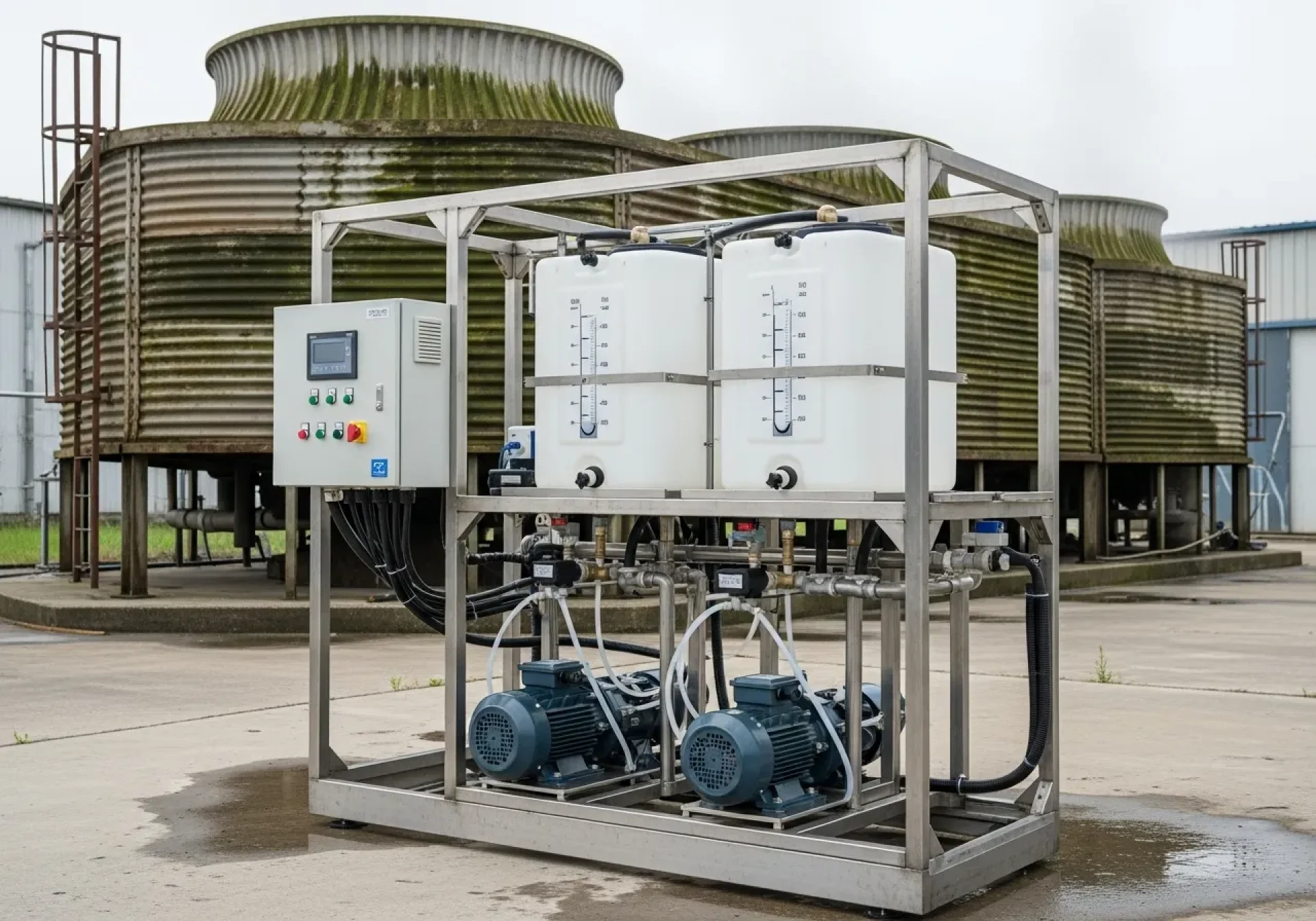
A chemical skid is a pre-assembled chemical dosing package, factory-tested by the manufacturer on a single base, and then installed on-site. This reduces piping, electrical, and control work on-site, increasing installation speed and quality consistency. For Cooling Towers, the main purpose is to control scale, corrosion, biofouling (including Legionella), and manage Cycles of Concentration (CoC) via the bleed-off circuit to keep it in an economical and safe range.
Main Components of a Skid
A typical architecture includes chemical tanks (inhibitor, biocide, pH adjuster, antifoam, etc.) with level transmitters and secondary containment, dosing pumps (often in duty/standby), valves/check valves, manifolds/flow indicators, and instrumentation (e.g., pH/ORP/Conductivity) connected to a PLC/SCADA for time-based or feedback-based control, including alarms for abnormalities like low/high level, no flow, or pipe blockage.
Key Variables to Define:
- Chemical type and concentration: scale inhibitor, corrosion inhibitor, oxidizing/non-oxidizing biocide, pH control.
- Flow rate/accuracy: pump stroke/Hz, control range, response to actual load.
- Wetted materials: PVC/CPVC/PP/PVDF/SS316/FRP to match chlorides, temperature, and solvents.
- Interlocks/Safety: bund, leak detection, E-stop, shower/eyewash near the work area.
- Dosing strategy: fixed vs feedback (ORP/cond/pH), alternating biocide to reduce microbial resistance.
Designing for Stability, Safety, and Real-System Integration
Material selection must consider chemicals, temperature, pressure, chlorides, and UV rays. If outdoors, it should have sun/rain/ventilation protection that doesn't trap chemical vapors. Suction/discharge piping should be kept as short as possible, reduce air pockets, and consider a degassing head for off-gassing chemicals. Delivery piping to the injection point should use double-contained tubing in high-risk areas and have a non-return valve at the injection point to prevent backflow. Furthermore, interlocking the skid with the bleed valve, make-up valve, and fan/pump VFDs ensures chemical control is related to the actual thermal operation, avoiding "floating doses" (unnecessary dosing) at low loads.
Testing and Handover: Operational from Day One
Before delivery, a FAT (Factory Acceptance Test) should test I/O accuracy, interlock sequences, and pump flow rates. An SAT (Site Acceptance Test) should check actual injection points, piping, and signal quality (pH/ORP/Conductivity). P&ID/As-built/Loop diagrams must be updated, along with a spare parts manual (diaphragm/valve kit) and a PM plan specifying calibration/replacement intervals for critical parts.
Professional Handover Checklist:
- Verify dosing pump flow test against setpoints across the entire range.
- Test that interlocks (low level, leak, E-stop, bleed/make-up) function according to logic.
- Check that wetted materials are correct at all points (pipes, fittings, valves, seals).
- Confirm grounding/shielding of signal cables to reduce noise from VFDs.
- Record baseline water quality: pH/cond/alkalinity/hardness before starting control.
Effective Chemical Dosing Strategy for Cooling Towers
The key concept is to correlate the chemical amount with the actual thermal load and evaporation, adjusting bleed-off via conductivity and controlling ORP for oxidizing biocides, combined with an alternating program (switching biocide types) to reduce microbial resistance. Setting alarm bands too narrow can cause the system to "oscillate"; start with a safe range and adjust based on real data.
Preventive Maintenance and Safety
Establish regular checks for pump stroke/diaphragms, clean strainers/filters, inspect check valves, and test leak sensor and shower/eyewash functionality. For safety, adhere to LOTO before all repairs, use PPE according to the SDS, and create SOPs for chemical storage/mixing to reduce risks from vapors and spills.
Troubleshooting Quick Guide:
- Scale forms quickly on fill/heat exchanger: Low inhibitor / insufficient bleed Check concentration, adjust CoC/bleed, verify dosing rate.
- Odor/slime/low ORP: Insufficient biocide / non-alternating program Increase dose/switch type, check for dead-legs/flow zones.
- Excessive foaming: Overdosing / product contamination Reduce dose/change chemical, check injection point/mixing.
- Pump strokes but no flow (air-locked): Air trapped / stuck suction/discharge valve Prime/bleed air, clean/replace valve kit.
- Conductivity value erratic: Dirty sensor / EMI from VFD Clean probe, check shielding/grounding, set averaging filter.
Summary: Good Skid = Precise Chemical Control = Stable Cooling System
A chemical skid that is correctly specified for the actual water and properly integrated with the Cooling Tower's control system will accurately manage scale, corrosion, and biofouling. This reduces energy loss from poor heat transfer, extends equipment life, and ensures long-term operational stability. All this is achievable with good design, complete testing, and disciplined maintenance from day one.