What is a Heat Exchanger? The Complete Guide to Types, Selection & Maintenance
Key Takeaways
- A heat exchanger is a device that transfers heat between two fluids without letting them mix.
- The main types are shell & tube (high pressure), plate (high efficiency, compact), and air-cooled (no water needed).
- Selection depends on the fluids, pressure, temperature, and the heat load to be transferred.
- Fouling is the primary enemy that lowers the heat transfer coefficient and raises energy costs.
- Preventive maintenance and scheduled cleaning preserve efficiency and extend service life.
What is a Heat Exchanger? Understanding the Heart of Industrial Heat Management
In every industrial process involving heat, from oil refineries and chemical plants to power generation and the food and beverage industry, one component works quietly in the background yet plays a vital role: the Heat Exchanger.
1. What is a Heat Exchanger?
A heat exchanger is a device engineered to transfer heat between two fluids (which may be liquid-to-liquid, liquid-to-gas, or gas-to-gas) without allowing those fluids to mix. The principle is straightforward: a hot fluid transfers heat through a separating wall (such as a tube or metal plate) to a cooler fluid, enabling effective heat recovery or process cooling. A well-designed exchanger can significantly reduce energy use and lower production costs.
2. Main Types of Heat Exchangers
Choosing the right type for the job is paramount. The main types found in industry are:
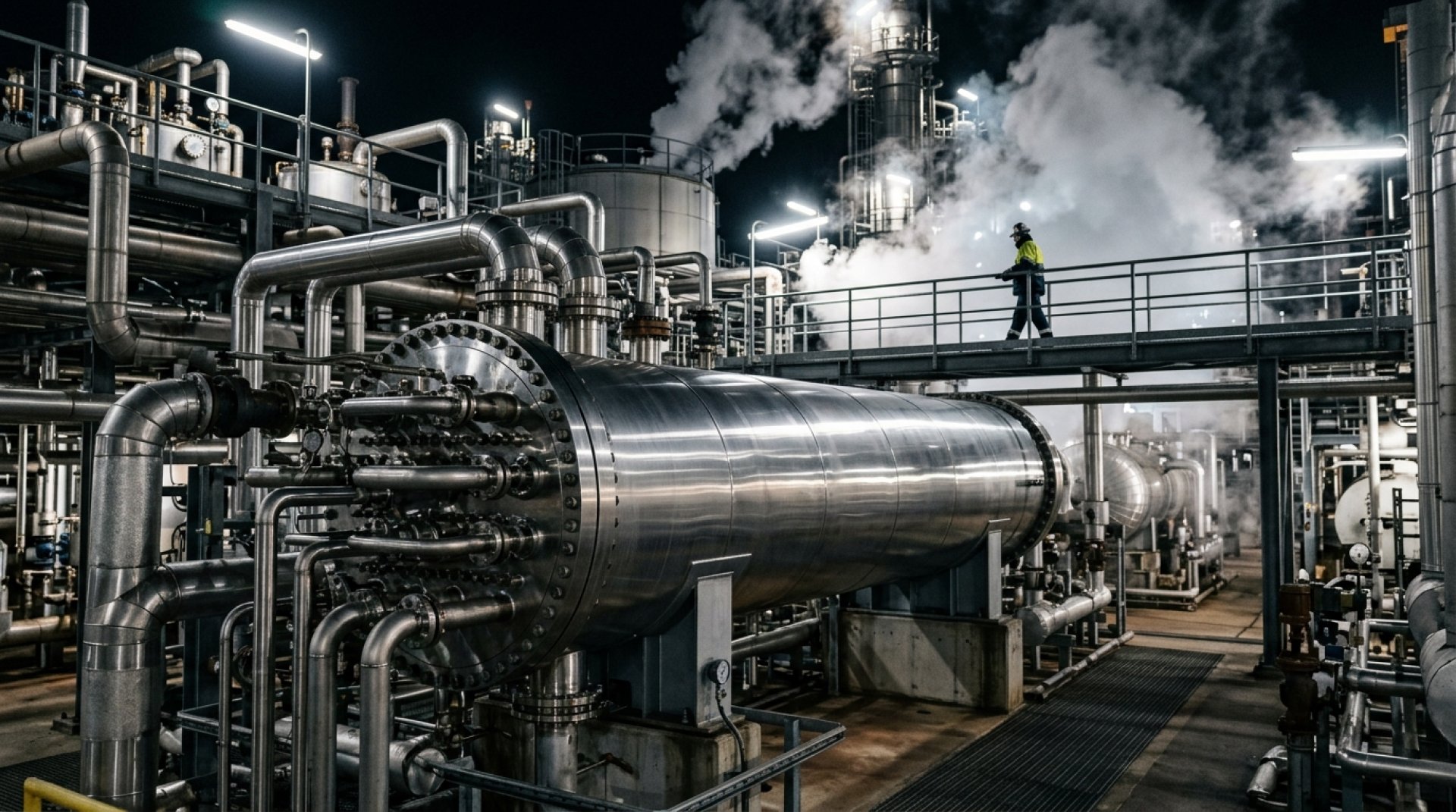
- Shell and Tube Heat Exchanger: The most common type in heavy industry, consisting of a tube bundle housed within a cylindrical shell. One fluid flows through the tubes while the other flows around them. Its strengths are tolerance of high pressure (hundreds of bar) and high temperature, large heat-load capacity, and maintainability, since the tube bundle can be pulled out and cleaned. The trade-offs are its large footprint and heavy weight, making it best suited to refining and petrochemical duties that prize durability over compactness.
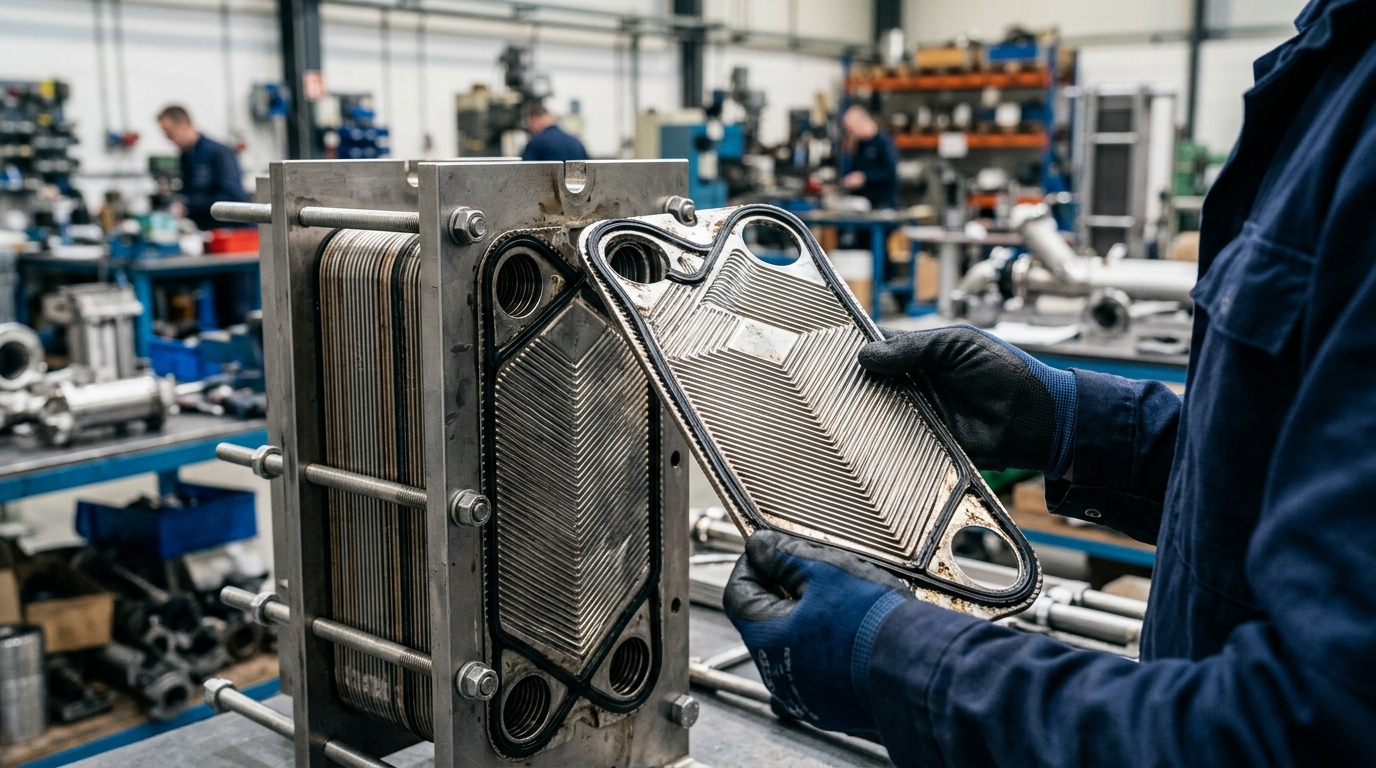
- Plate Heat Exchanger: Uses stacked corrugated metal plates that create alternating channels for hot and cold fluids. Its advantages are very high heat transfer efficiency, with an overall coefficient several times higher than a shell & tube unit of the same size, a compact footprint, and easy capacity adjustment by adding or removing plates when the heat load changes. Its limitations are that the gaskets tolerate only limited pressure and temperature, and the narrow flow channels clog easily, so it is unsuitable for fluids carrying large particles.
- Air-Cooled Heat Exchanger: Uses air blown across a finned tube bundle instead of cooling water, suitable where water is scarce or costly. It eliminates water-treatment costs and the need for a cooling tower, but its performance depends on ambient air temperature and degrades on very hot days. It operates on the same principle as a heat dissipation panel.
3. How to Choose the Right Heat Exchanger
The correct choice requires evaluating these engineering factors:
- Fluid Type and Properties: Viscosity, corrosiveness, and dirtiness of the fluids dictate the appropriate material and type. Highly corrosive fluids may demand stainless steel, titanium, or nickel-alloy tubes, while fluids heavy with sediment call for designs that are easy to clean and have wide flow channels.
- Operating Pressure and Temperature: High-pressure duties typically demand shell & tube designs, because the shell and tubes handle pressure better than the gaskets of a plate unit, while high-temperature duties must account for material thermal expansion and thermal fatigue.
- Heat Duty and LMTD: The amount of heat to be transferred (the duty, in kilowatts), together with the log mean temperature difference (LMTD) and the overall heat-transfer coefficient (U), determines the required surface area via the equation Q = U × A × LMTD.
- Allowable Pressure Drop: Designing for higher fluid velocity boosts heat transfer but also raises the pressure drop and pumping load, so engineers must balance thermal performance against pumping cost.
- Installation Space and Budget: Plate units suit tight spaces, air-cooled designs reduce dependence on a water source, and shell & tube units often have a lower cost per unit of surface area on large duties.
Additionally, the flow arrangement affects performance. Counterflow, where the two fluids move in opposite directions, produces a higher mean temperature difference and transfers heat more effectively than parallel flow, which is why it is preferred in most applications. Understanding this principle helps you select and install the equipment correctly.
4. Efficiency, Fouling, and Maintenance
The most formidable enemy of a heat exchanger is fouling, the buildup of scale, sediment, and dirt on the heat-transfer surface. Acting like an insulating layer, it reduces the heat transfer coefficient, forcing the system to work harder and consume more energy. Fouling comes in several forms: mineral scaling from hard water, sedimentation of suspended particles, biofouling from microbial growth, and corrosion that leaves oxide deposits on the tube surface. Identifying the true cause is what lets you choose the right prevention and cleaning method.
Good maintenance practices include:
- Monitoring Pressure Drop and Temperature: A rising pressure drop or abnormal outlet temperature is a classic sign of fouling.
- Scheduled Cleaning: Mechanical cleaning for shell & tube units, such as high-pressure hydroblasting or pushing brushes through the tubes, and clean-in-place (CIP) chemical cleaning that circulates an acid or alkaline solution through plate units without disassembly.
- Water Quality Management: For water-cooled systems working alongside a cooling tower, controlling water quality greatly reduces fouling.
Designing in a fouling factor from the start is equally important. Experienced engineers add a small margin of heat-transfer surface area so the system still meets its target even as deposits begin to accumulate between cleaning cycles. Overlooking this often means a system that is "exactly right" on installation day falls short of its target just a few months later.
5. Industrial Applications
Heat exchangers are used extensively, for waste-heat recovery, vapor condensing, feedstock preheating, process cooling, and large HVAC systems. In power plants, they condense steam back into water; in food and beverage facilities, they pasteurize and cool products hygienically; and in petrochemical and refining operations, they are central to controlling temperatures in distillation columns and reactors.
Choosing the right type and maintaining it properly therefore directly affects energy cost, product quality, and process safety. Innovek specializes in selecting, sourcing, and advising on heat-exchange equipment to help your plant manage thermal energy efficiently and sustainably.