What is a Closed Loop Cooling Tower? Closed vs Open Circuit Explained
Key Takeaways
- A closed loop cooling tower circulates the process fluid inside a closed coil that never directly contacts outside air, keeping it clean.
- This differs from an open loop system, where process water contacts air directly and risks dirt, scaling, and contamination.
- The main benefit is protecting fouling-sensitive equipmentchillers, induction furnaces, injection moldsand reducing process-side maintenance.
- The trade-off is higher initial cost, a larger footprint, and slightly lower efficiency due to the extra heat-transfer step.
- Choosing between closed and open comes down to the cleanliness your equipment needs, ambient air quality, and lifetime budget.
What is a Closed Loop Cooling Tower? Understanding the Closed Circuit System
In a plant's cooling system, the question a design engineer must answer early is: "Open loop or closed loop cooling tower?" Getting it wrong from the start affects the cleanliness of your coolant, the life of downstream equipment, and years of maintenance cost. This article explains what a closed loop cooling tower is, how it differs from an open system, and which to choose for your application. To review how cooling towers work first, read our complete guide to cooling towers.
1. How the Closed Circuit Works
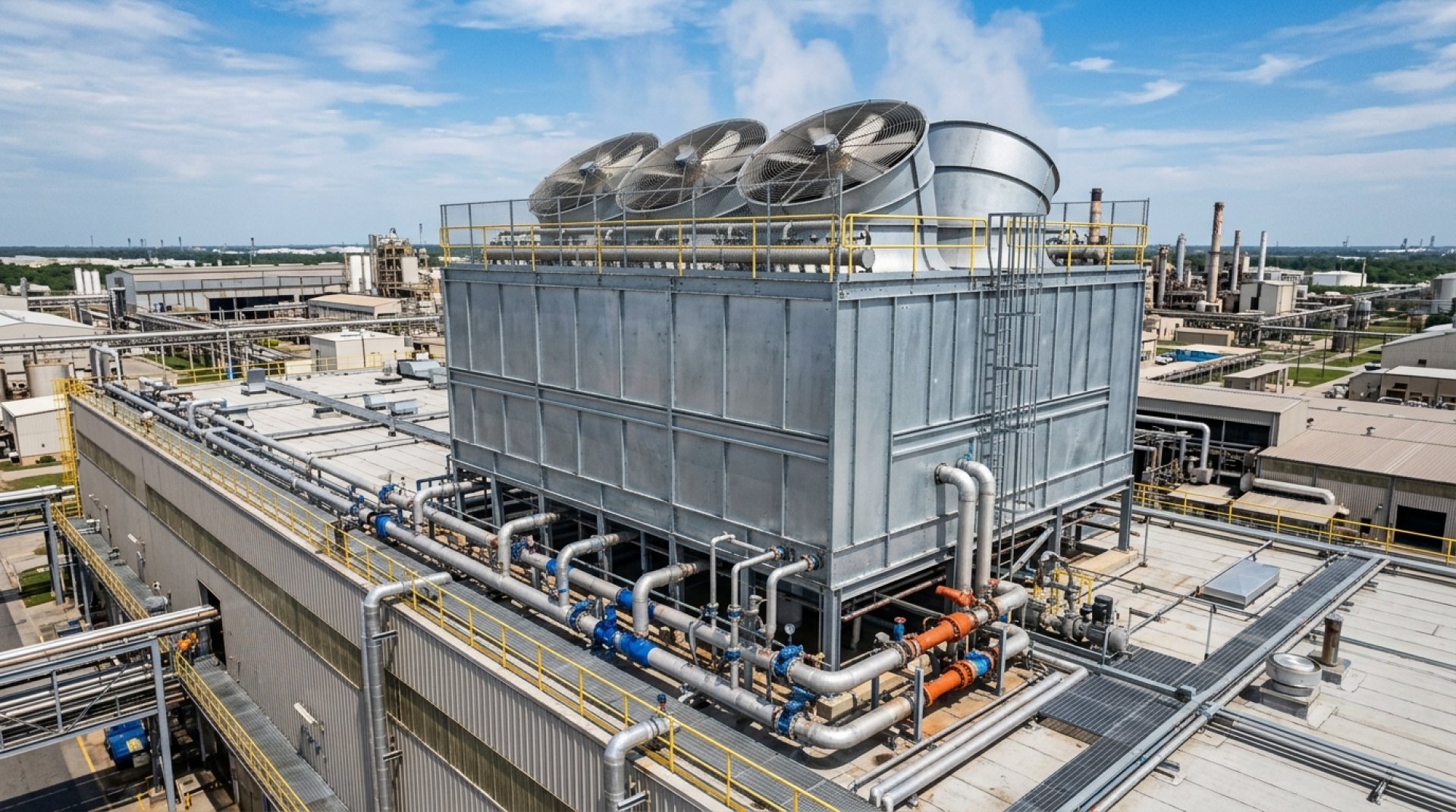
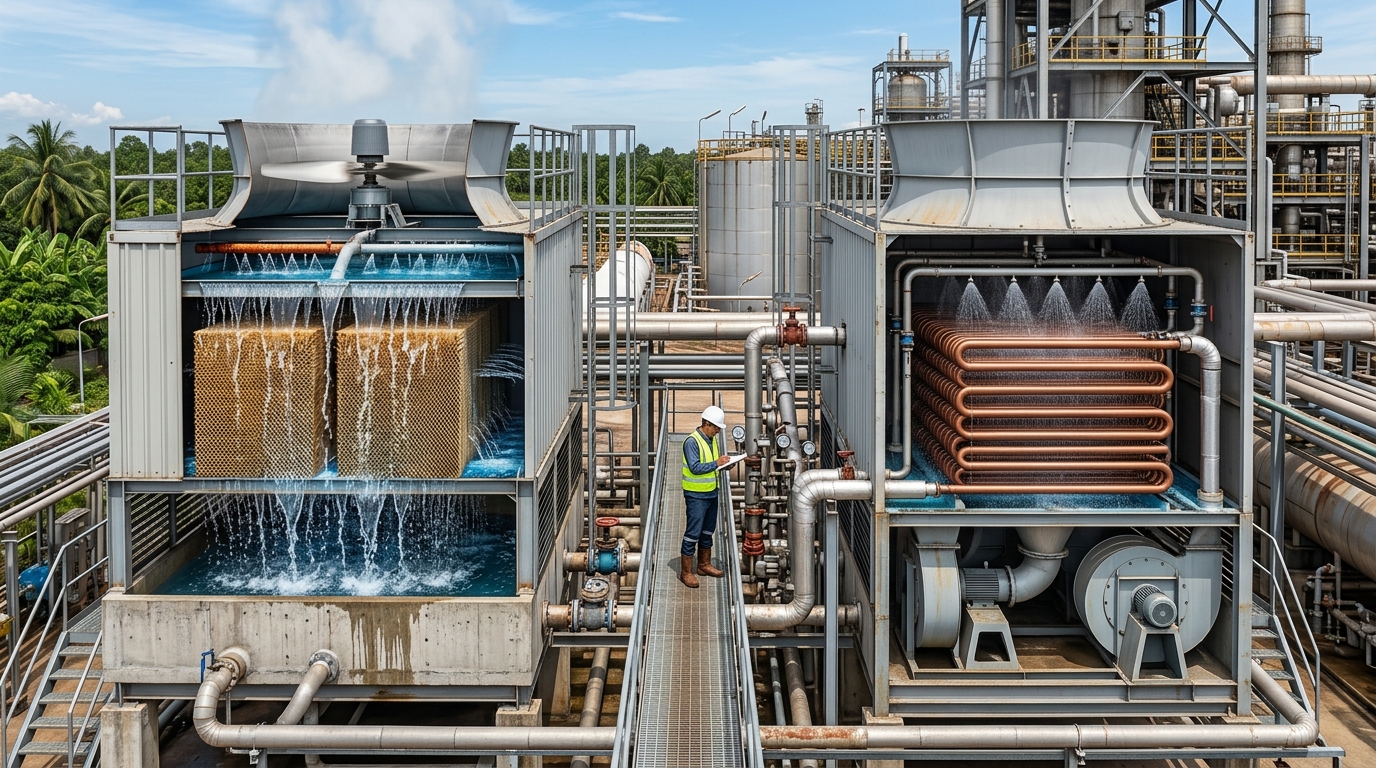
A closed loop cooling tower (or closed circuit cooling tower) circulates the process fluid inside a closed coil that never contacts outside air. Heat from the fluid transfers through the coil walls to spray water flowing over the coil surface, and fans then draw air through the coil to evaporate some of the spray water and carry the heat away. In other words, it still uses evaporative cooling like an open system, but it clearly separates the "process fluid circuit" from the "spray water and air circuit." The result is that the fluid returning to cool your equipment stays just as clean, all the time.
2. How Closed Loop Differs from Open Loop
In an open system, process water cascades down and contacts air directly through fill media (Fill Pack); part of it evaporates to remove heat. The advantages are high heat-transfer efficiency and low cost, but because the water contacts air directly, it readily picks up dust, spores, algae, and airborne dirt. Evaporation also concentrates minerals and easily causes scaling in downstream equipment.
By contrast, a closed system keeps the process fluid from ever touching air. Airborne contaminants accumulate in the external spray-water circuit instead, which is far easier to maintain and cleanwithout affecting the cleanliness of the water cooling critical equipment. This fundamental difference makes closed systems ideal where "coolant cleanliness" matters more than cost.
3. Benefits of a Closed Loop Cooling Tower
- Protects fouling-sensitive equipment: Induction furnaces, welders, chillers, lasers, and injection molds have very narrow water passages that clog and fail easily with dirty water. A closed system clearly extends their life.
- Reduces process-side maintenance: With clean fluid, downstream piping and heat exchangers barely foul, cutting cleaning frequency and downtime.
- Enables freeze protection: You can add glycol to the closed circuit, ideal for low-temperature control.
- Easier water-quality control: Because the closed-circuit fluid volume is stable and not lost to evaporation, dosing and control are precise.
4. Trade-offs to Accept
No system is perfect. A closed system's trade-offs include higher initial cost (CAPEX) than an open system of the same cooling capacity, because it needs an extra coil; larger size and weight; and slightly lower overall efficiency, since it adds one heat-transfer step (fluid through the coil wall before reaching the spray water). This makes it harder for the outlet water to approach the wet-bulb temperature than an open system. Still, for the right application, the cleanliness and equipment-protection benefits usually far outweigh the added cost.
5. Don't Forget the Spray-Water Circuit
Although a closed system keeps the process fluid clean, the external spray-water circuit is still an open system exposed to air, so it needs proper water treatment too. Constantly evaporating spray water concentrates minerals and forms scale on the coil surface, which directly lowers heat-transfer efficiency. Controlling water concentration, dosing anti-scalant and biocide to suppress bacterial growth including Legionella, and periodic blowdown are all ongoing tasks. Components such as drift eliminators and water-distribution media also reduce water loss and spread water evenly across the coil surface. Neglecting the spray-water circuit erodes the closed system's cleanliness advantage, because the coil simply scales from the outside insteadforcing more frequent cleaning shutdowns than necessary.
6. Closed or OpenWhich Should You Choose?
A simple rule: choose a closed system when downstream equipment is sensitive to fouling or contamination, needs consistently clean coolant, sits in a dusty or polluted location, or operates in cleanliness-strict industries like food, pharma, and electronics. Conversely, choose an open system when low cost, high cooling capacity per size, and a process fluid tolerant of dirt are your priorities. The best decision considers lifetime cost, not just the day-one price, and should be designed with an expert who understands both systems.
Innovek's engineering team can advise on selecting and designing both open and closed cooling systems to suit your plant's equipment and budget. Contact us for an initial assessment.