Water and Energy-Saving Innovations for Cooling Towers in 2026
Last updated: 15 Mar 2026
1503 Views
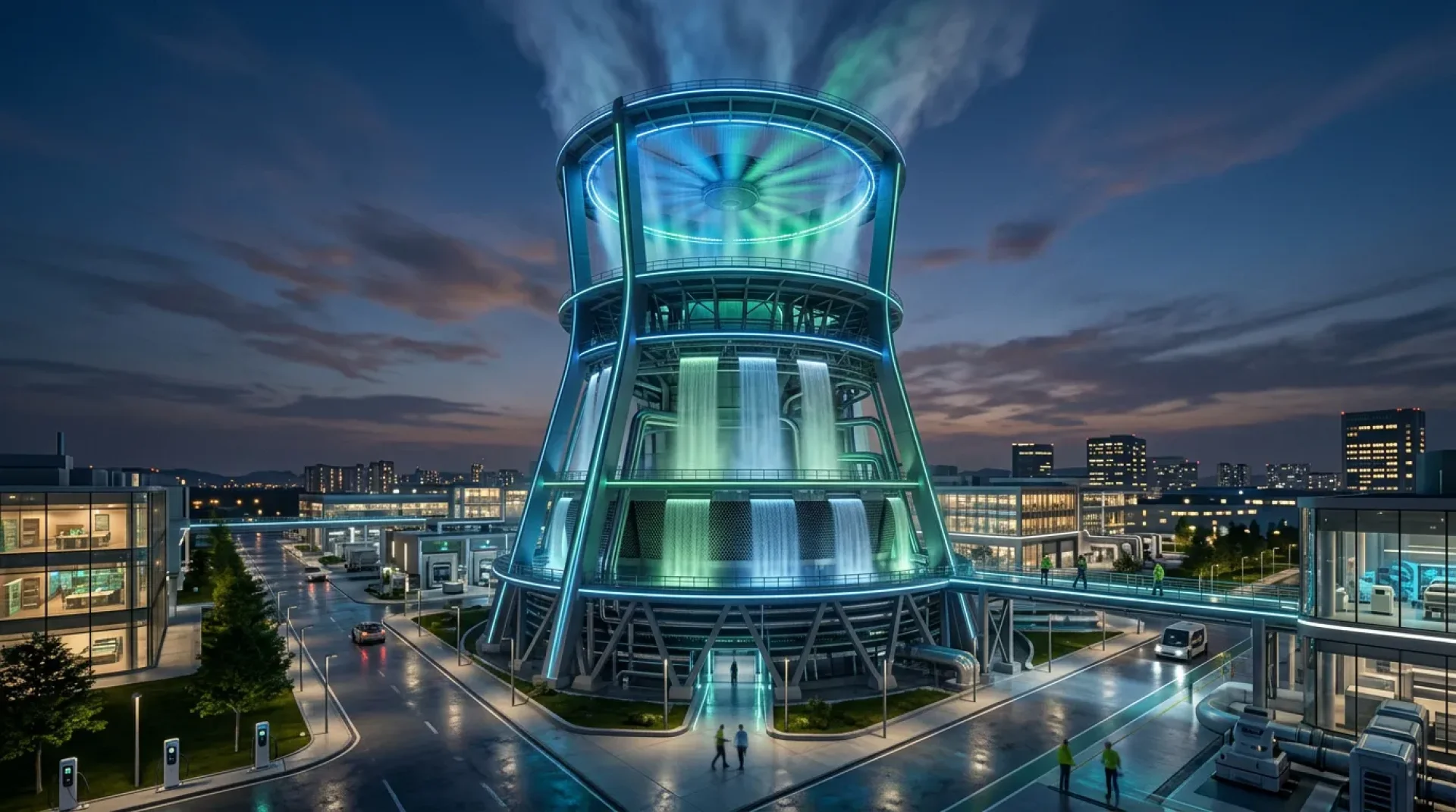
In the current era where Climate Change and water scarcity have become urgent global agendas, Sustainability standards and ESG (Environmental, Social, and Governance) frameworks are no longer merely an 'option' for corporate branding, but have become mandatory rules shaping the industrial sector's direction. For large-scale manufacturing plants and power plants, the 'Cooling Tower' is one of the equipment pieces that consumes the highest amount of water and electrical energy. Therefore, upgrading cooling technologies has become a crucial battleground that plant executives must prioritize. In 2026, engineering innovations have taken another step forward to address this challenge. Today, we will dive deep into 3 core technologies that will revolutionize heat management to be eco-friendly while sustainably reducing costs.
1. Advanced Drift Eliminators: The Innovation to Stop Water Loss into the Sky
One of the most resource-wasting classic problems of open-loop cooling towers is a phenomenon called 'Drift'. This refers to tiny water droplets being pulled by the fan's draft and carried out of the tower along with the exhausted hot air. These droplets are not just pure water; they are mixed with minerals and water treatment chemicals. Allowing these droplets to escape means not only a massive loss of pure water that must be replenished (Make-up water) but can also cause damage to the surrounding environment and induce rust on nearby steel structures.
To solve this problem, the new generation of Drift Eliminators in 2026 has been developed using Computational Fluid Dynamics (CFD). These droplet-catching panels are designed with complex aerodynamic profiles, forcing the airflow to rapidly change direction. Consequently, water droplets—which are heavier than air—collide with the panel walls and flow back into the cooling basin below. The latest technology can capture up to 99.005% of the total circulating water droplets, significantly reducing water loss and helping plants save massively on annual municipal water bills.
2. Variable Frequency Drives (VFD): The Genius of Electrical Energy Control
In the past, cooling tower fan motors were often set to run at 100% full capacity (Single-speed) continuously, regardless of whether the outside weather was scorching hot or comfortably cool—a massive waste of energy. The introduction of Inverter systems, commonly known as Variable Frequency Drives (VFD), truly revolutionizes industrial energy conservation.
VFD systems work in tandem with temperature sensors, dynamically adjusting the fan's rotational speed (RPM) to match the machine's 'Heat Load' and the weather's real-time 'Wet-bulb temperature'. The brilliance of this system is based on the Affinity Laws, which state that the electrical power consumed by a motor is proportional to the cube of its rotational speed. This means that if the weather cools down and the VFD reduces the fan speed by just 20% (operating at 80%), the motor will consume nearly 50% less electrical energy! Installing VFDs is therefore one of the energy conservation projects with the fastest payback periods.
3. Smart Sensors and IoT Technology: Stepping into the Smart Industry Era
Integrating the Internet of Things (IoT) into cooling systems is a major turning point in 2026. Engineers no longer need to walk around and manually record values on-site. With Smart Sensors installed throughout the system, all data—from inlet/outlet water temperatures, flow rates, and gearbox vibration to conductivity for measuring mineral density in the water—is sent directly to a centralized control panel.
This precise data enables 'Automated Blowdown' systems. The system will discharge water only when mineral levels reach a critical point that could cause scaling, rather than using the random timed blowdown methods of the past. This saves a tremendous amount of water. Furthermore, AI analyzes this data to perform Predictive Maintenance, foreseeing potential damages before components fail.
If your plant is looking for experts in upgrading systems for sustainability, the engineering team at Innovek is ready to provide consultation and design state-of-the-art systems to enhance your competitive edge.
1. Advanced Drift Eliminators: The Innovation to Stop Water Loss into the Sky
One of the most resource-wasting classic problems of open-loop cooling towers is a phenomenon called 'Drift'. This refers to tiny water droplets being pulled by the fan's draft and carried out of the tower along with the exhausted hot air. These droplets are not just pure water; they are mixed with minerals and water treatment chemicals. Allowing these droplets to escape means not only a massive loss of pure water that must be replenished (Make-up water) but can also cause damage to the surrounding environment and induce rust on nearby steel structures.
To solve this problem, the new generation of Drift Eliminators in 2026 has been developed using Computational Fluid Dynamics (CFD). These droplet-catching panels are designed with complex aerodynamic profiles, forcing the airflow to rapidly change direction. Consequently, water droplets—which are heavier than air—collide with the panel walls and flow back into the cooling basin below. The latest technology can capture up to 99.005% of the total circulating water droplets, significantly reducing water loss and helping plants save massively on annual municipal water bills.
2. Variable Frequency Drives (VFD): The Genius of Electrical Energy Control
In the past, cooling tower fan motors were often set to run at 100% full capacity (Single-speed) continuously, regardless of whether the outside weather was scorching hot or comfortably cool—a massive waste of energy. The introduction of Inverter systems, commonly known as Variable Frequency Drives (VFD), truly revolutionizes industrial energy conservation.
VFD systems work in tandem with temperature sensors, dynamically adjusting the fan's rotational speed (RPM) to match the machine's 'Heat Load' and the weather's real-time 'Wet-bulb temperature'. The brilliance of this system is based on the Affinity Laws, which state that the electrical power consumed by a motor is proportional to the cube of its rotational speed. This means that if the weather cools down and the VFD reduces the fan speed by just 20% (operating at 80%), the motor will consume nearly 50% less electrical energy! Installing VFDs is therefore one of the energy conservation projects with the fastest payback periods.
3. Smart Sensors and IoT Technology: Stepping into the Smart Industry Era
Integrating the Internet of Things (IoT) into cooling systems is a major turning point in 2026. Engineers no longer need to walk around and manually record values on-site. With Smart Sensors installed throughout the system, all data—from inlet/outlet water temperatures, flow rates, and gearbox vibration to conductivity for measuring mineral density in the water—is sent directly to a centralized control panel.
This precise data enables 'Automated Blowdown' systems. The system will discharge water only when mineral levels reach a critical point that could cause scaling, rather than using the random timed blowdown methods of the past. This saves a tremendous amount of water. Furthermore, AI analyzes this data to perform Predictive Maintenance, foreseeing potential damages before components fail.
If your plant is looking for experts in upgrading systems for sustainability, the engineering team at Innovek is ready to provide consultation and design state-of-the-art systems to enhance your competitive edge.
Related Content
A heat exchanger is a device used to transfer thermal energy from one fluid or gas to another without allowing the two substances to come
8 Jul 2025

A clear comparison between Cooling Towers and Heat Exchangers: Which system best suits your plant? Dive into their pros, cons, and the secret of combining them in a Closed-loop system to extend machinery lifespan and achieve sustainable energy savings.
15 Mar 2026
Cooling towers are large pieces of equipment that require regular maintenance. By planning the maintenance of cooling towers correctly To reduce repair costs
26 Feb 2025