What is an Air-Cooled Heat Exchanger? When to Cool with Air Instead of Water
Key Takeaways
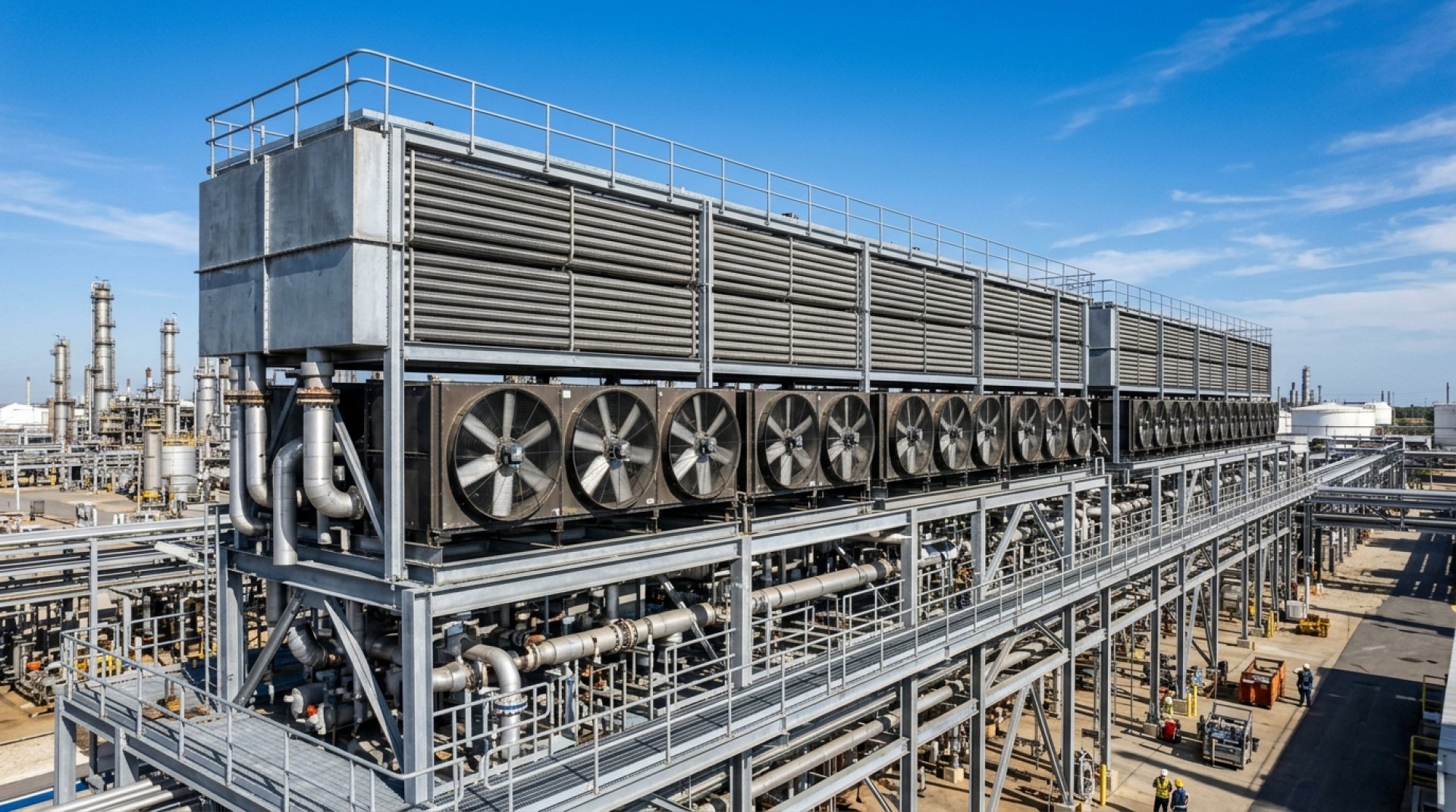
- An air-cooled heat exchanger (ACHE) blows air across finned tubes to reject heat instead of using water.
- There are two main types by fan position: forced draft (fan below pushing air up) and induced draft (fan above pulling air through).
- The main benefit is needing no cooling watercutting water treatment and water costs and avoiding a cooling towerideal where water is limited.
- The limitation is that performance depends on ambient air temperature, degrading on very hot days, and it needs a large footprint.
- An ACHE works on the same principle as a heat dissipation panel and is an alternative to a cooling tower in many applications.
What is an Air-Cooled Heat Exchanger (ACHE)? Understanding Cooling with Air
In many parts of Thailand and the region, clean water for cooling systems is becoming an increasingly costly resourcethrough water charges, treatment costs, and environmental limits. The question design engineers ask more often is: "Do we really need a cooling tower and water?" In many cases the answer is an air-cooled heat exchanger (ACHE). This article explains its principle, pros and cons, and when to choose it. For an overview of all heat exchanger types first, read our complete guide to heat exchangers.
1. How an ACHE Works
An air-cooled heat exchanger (often abbreviated ACHE or called a fin-fan cooler) rejects heat from a process fluid using air blown across finned tubes instead of cooling water. The hot fluid flows inside the tubes, while metal fins around the tubes vastly increase the surface area in contact with air; large fans then force air through these fins to carry heat into the atmosphere. The principle is like a car radiator scaled up for industryand it is the same principle as a heat dissipation panelexcept an ACHE is designed to handle large, continuous process heat loads.
2. Forced Draft vs Induced Draft
ACHEs are classified by fan position into two main types with different strengths:
- Forced draft (fan below): The fan sits under the tube bundle and pushes air up through the fins. Its advantage is that the fan and motor run in cool air before it picks up heat, so they operate at a lower temperature and are easy to access for maintenance. The downsides are less uniform air distribution through the bundle and a greater chance of hot-air recirculation.
- Induced draft (fan above): The fan sits above the tube bundle and draws air up through the fins. Its advantage is more uniform air distribution and less hot-air recirculation. The downside is that the fan and motor must work in the heated air that has passed through the bundle, requiring temperature-rated materials.
The choice depends on site conditions, heat load, and maintenance requirements.
3. Benefits of Cooling with Air
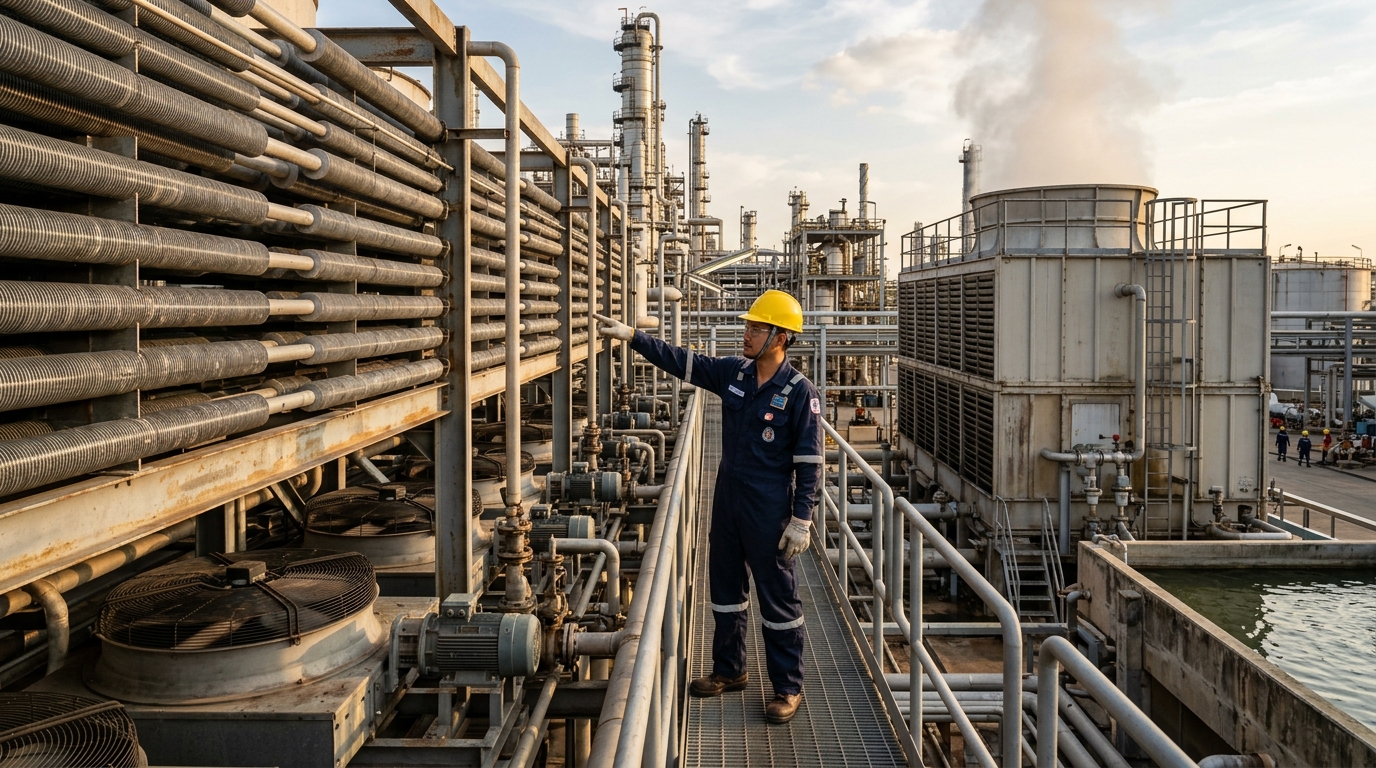
- No cooling water needed: Eliminates almost all water charges, treatment chemicals, and wastewater handling.
- Less reliance on cooling towers: No cooling tower, water pumps, or large coolant piping, simplifying the utility system.
- Ideal where water is limited: Perfect for remote or arid sites, or those with restrictions on water use and discharge.
- Less water-side maintenance: With no coolant circuit, scaling, algae, and water-driven corrosion problems all decrease.
4. Limitations to Consider
The most important limitation of an ACHE is that its performance is tied directly to ambient air temperature. Because air is the heat sink, the cooled fluid temperature cannot fall below ambient, and on very hot days the cooling capacity dropsunlike evaporative water cooling, which references the lower wet-bulb temperature. In addition, ACHEs occupy a large footprint, carry fan power consumption worth accounting for, and can be noisy. Good design must therefore allow a suitable design ambient temperature for Thailand's hot, humid climate.
5. ACHE Maintenance and Designing for Thailand's Climate
Because an ACHE relies on air flowing through the fins, its main enemy is fins clogged by dust, leaves, insects, or oil film, which block airflow and cause a rapid drop in performance. Periodic fin cleaning with pressurized water or air is therefore a core maintenance task that must not be neglected. You must also keep the fan drivemotor, gearbox or belts, and drive shaftin good condition and correctly aligned, just like a cooling tower's fan drive system. For Thailand's hot, humid climate, setting a high enough design ambient temperature and positioning the unit to minimize hot-air recirculation are essential, because a design based on an unrealistically low temperature will fail to reject enough heat on the hottest dayswhich is usually exactly when the process needs cooling most.
6. When to Choose an ACHE Over Water
In summary, consider an ACHE when water is costly or hard to obtain, when you want to reduce the complexity and maintenance burden of a water system, when the plant faces environmental limits on water, or when the process fluid does not require a very low final temperature that only water evaporation can provide. Conversely, if you need the lowest possible outlet temperature and have ample water, a cooling tower may still be more efficient. A good decision weighs water cost, space, energy, and target temperature together.
Innovek's engineering team can assess and design both air-cooled (ACHE) and water-based cooling systems to fit your site conditions and budget. Contact us for a consultation.